Software Can Save Money. Intelligence Can Create It.
See how Resurve combines operational and financial data to reveal vehicle performance, surface better decisions and turn business insight into action.
Marketing · 19 Aug 2026 · 8 min
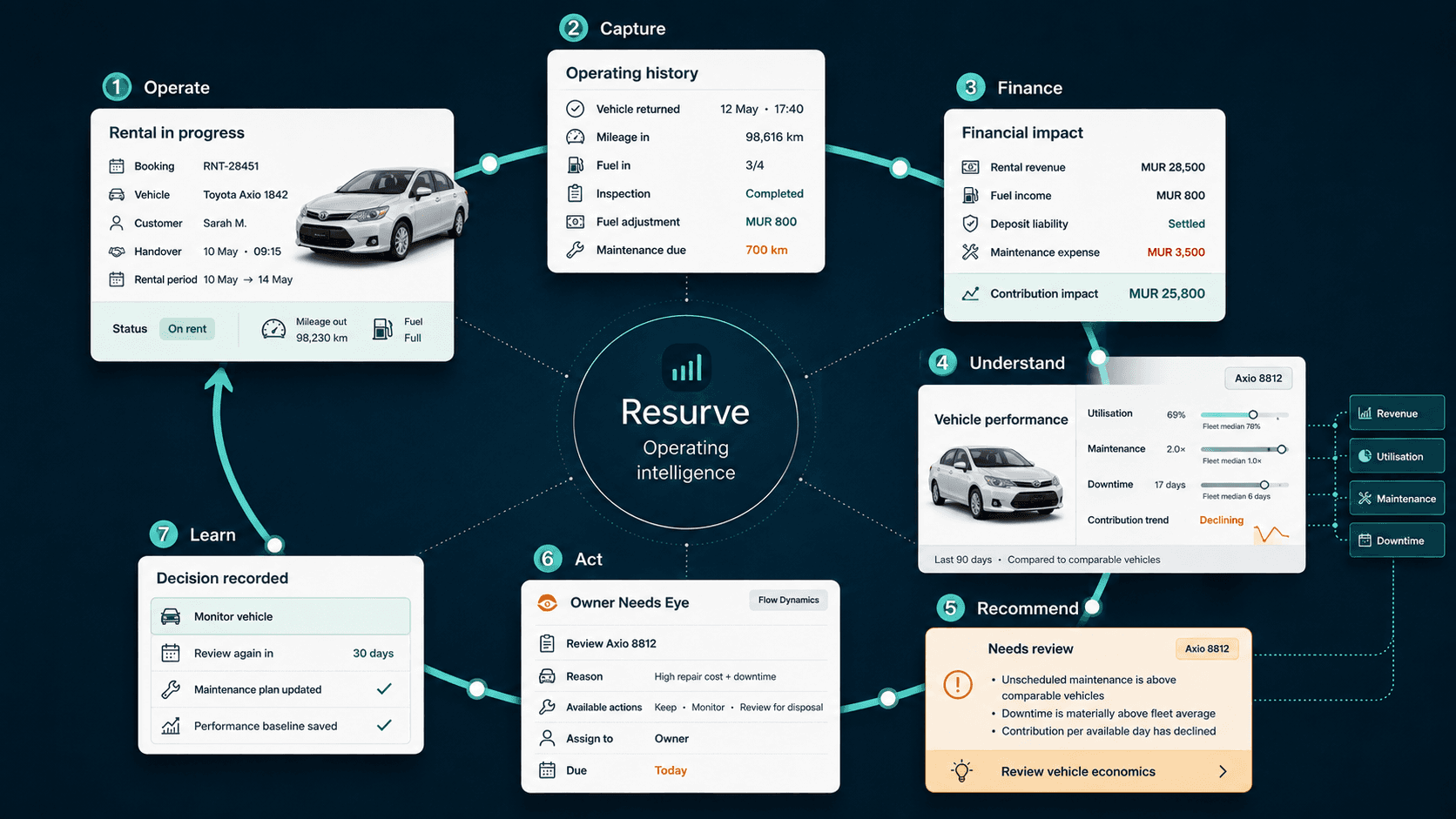
Most software helps a business record what happened.
We think Resurve can eventually help explain what happened — and what may be worth doing next.
⸻
A car-rental business can already buy software for bookings.
It can buy accounting software.
Fleet software.
Analytics software.
Each one can answer useful questions.
But there is a difference between having data and understanding the economics of the business.
An accounting system might tell an operator:
Repairs this year: MUR 480,000
That matters.
But the more interesting questions are:
Which cars caused those repairs? · How much revenue did those cars generate? · How often were they unavailable? · Were comparable vehicles more profitable? · Should we keep putting money into them?
Those questions require something accounting alone does not have.
They require operational truth and financial truth to meet.
⸻
The numbers become more useful when they have context
Imagine two cars.
Toyota Axio 1842
Revenue: MUR 310,000 · Maintenance: MUR 28,000 · Downtime: 6 days · Utilisation: 81%
Nissan Note 2217
Revenue: MUR 265,000 · Maintenance: MUR 79,000 · Downtime: 24 days · Utilisation: 62%
An accounting system can record all of those expenses correctly.
A fleet system can record mileage and maintenance.
A booking system can record utilisation.
But when those truths sit together, a different question becomes possible:
Is Nissan Note 2217 still a good use of capital?
That is no longer bookkeeping.
That is a business decision.

The journey is Record → Automate → Understand → Improve
We see the product evolving through four stages:
Record → Automate → Understand → Improve
1. Record
What happened?
Who rented the car?
Which vehicle?
For how long?
How much was paid?
What was the mileage?
Was there damage?
What did maintenance cost?
⸻
2. Automate
What work can disappear because Resurve already knows the answer?
If payment was collected, Finance should know.
If the rental was extended, the balance should update.
If part of a deposit was retained, the financial consequence should follow.
If something is known, move it automatically.
If something requires judgement, ask.
⸻
3. Understand
Now we can start combining the information.
Revenue + utilisation + maintenance + downtime + depreciation + operating history
Suddenly, the business can see more than totals.
It can see patterns.
⸻
4. Improve
This is where the value changes.
The question becomes:
What should we consider doing differently?
⸻
Analytics should not just produce more charts
There are already enough dashboards in the world.
A chart that says maintenance increased 18% may be useful.
But the owner still needs to work out why.
The more valuable version looks something like:
Review Nissan Note 2217
Maintenance cost: 2.1× fleet median
Downtime: 19% vs fleet median 6%
Revenue per available day: 23% below comparable vehicles
Utilisation: declining for three consecutive months
Suggested action: Review whether continuing to operate this vehicle still makes economic sense.
Now the system is doing more than reporting.
It is helping organise the evidence around a decision.
⸻
But intelligence should explain itself
There is a line we do not want to cross.
Resurve should not simply announce:
AI says sell this car.
That is not useful intelligence.
The owner may know something the system does not.
Maybe the car serves a strategic customer.
Maybe replacement vehicles are currently overpriced.
Maybe a large repair was exceptional rather than recurring.
Maybe the operator deliberately keeps that category available despite lower profitability.
So the recommendation should expose its reasoning.
Here is the evidence.
Here is what looks unusual.
Here is what may deserve attention.
Then the owner decides.
The purpose of intelligence is not to replace judgement. It is to improve the information available when judgement is required.
⸻
This can go far beyond individual vehicles
Once operating and financial truth are connected, the questions become much more interesting.
Resurve could eventually help an operator understand:
Which vehicle categories produce the highest contribution per available day?
Where are we regularly turning away demand?
Which cars spend too much time unavailable?
Which add-ons generate meaningful revenue with very little operating cost?
Which customers book earlier, stay longer or cancel less?
Which days produce the strongest economics?
Where is maintenance consuming an unusual share of revenue?
Which assets should we consider acquiring next?
Those are the kinds of questions larger businesses hire analysts to answer.
Small businesses usually do not have that luxury.
They often make these decisions from experience, instinct and whatever information happens to be available.
Experience will always matter.
But experience becomes more powerful when the data is organised around it.
⸻
And then Flow Dynamics can turn insight into action
This is where having intelligence inside the operating system becomes particularly important.
Most analytics products stop here:
Something looks wrong.
Resurve does not necessarily have to stop there.
Suppose the system detects:
Axio 8812 has unusually high repair costs.
Instead of leaving that insight buried inside a dashboard, it could become:
Owner Needs Eye → Review Axio 8812
The owner opens it.
They see:
Revenue · Utilisation · Maintenance · Downtime · Depreciation · Contribution
Then:
Keep · Monitor · Review for disposal
The insight becomes work.
The business acts.
And Resurve sees what happens next.
⸻
That creates a closed loop
Business operates → Operational truth accumulates → Finance captures the economics → Analytics finds patterns → Resurve surfaces a decision → Flow Dynamics creates the next action → Business acts → Resurve observes the result
Then the next recommendation has more history behind it.
That is very different from a dashboard somebody checks once a month.

This changes how we think about the value of software
Software traditionally creates value in three obvious ways:
Replace other software · Save employee time · Prevent mistakes
All three matter.
But intelligence introduces a fourth:
Help the business make better economic decisions.
And that can have a completely different value ceiling.
If Resurve saves an operator four hours of admin every month, that has value.
If it prevents a missed MUR 5,000 charge, that has value.
But if it helps an operator avoid buying the wrong MUR 900,000 vehicle?
Or identifies an underperforming asset six months earlier?
Or shows that one vehicle category is consistently turning away profitable demand?
The economics become very different.
⸻
The wrong comparison is Resurve versus one software subscription
It is easy to ask:
Why pay for Resurve when another tool costs less?
But that assumes the two products are doing the same job.
The better question is:
What does running the business without Resurve cost?
In software.
In staff time.
In duplicate work.
In missed charges.
In mistakes.
In vehicles sitting idle.
In maintenance nobody connected back to profitability.
In decisions made with incomplete information.
Software can reduce some of those costs.
Intelligence can potentially improve the economics that create the revenue in the first place.
⸻
Checkout still matters — but it no longer carries the entire thesis
Checkout remains an important part of Resurve.
It makes commerce easier.
It creates cleaner transaction data.
It reduces duplicate entry.
It connects customer payment directly to the rental.
And eventually, it can create additional opportunities around payments.
But our view of Resurve has changed.
We no longer think:
No checkout = no Resurve
Today, the product still has a strong reason to exist without it.
Because the rental file matters.
Flow Dynamics matters.
Finance matters.
Vehicle economics matter.
The owner still needs to understand the business.
Checkout becomes a powerful part of the system.
Not the system’s reason for existing.
⸻
The longer Resurve runs the business, the more useful it can become
On day one, Resurve helps operate the company.
Over time, it sees more:
Rentals · Revenue · Customers · Mileage · Maintenance · Repairs · Downtime · Utilisation · Cancellations · Deposits · Costs · Decisions
That history matters.
Not because the goal is to lock the business in.
But because the system can increasingly understand how that specific business behaves.
A new dashboard knows almost nothing.
A system that has watched thousands of rentals has context.
And context is what turns data into understanding.
⸻
That is the bigger Resurve thesis
Resurve is not simply about putting more software into a car-rental company.
It is about connecting the information that already exists around the business.
Operations create truth.
Finance gives that truth economic meaning.
Analytics turns it into understanding.
Intelligence helps turn understanding into better decisions.
Flow Dynamics turns decisions into work.
That is the loop.
And if we build it properly:
Resurve does not just help a car-rental company run. It helps the company understand how it runs — and where it may be able to run better.
That is where software starts becoming something more valuable.
Software can save money. Intelligence can create it.
Więcej

If Your Software Creates More Work, What’s the Point?
More features do not always make software better. This article looks at why good car rental software should handle complexity in the background while keeping everyday work simple for employees, managers and owners.
21 Aug 2026 · 3 min

You Shouldn’t Need to Become a Web Designer to Rent Cars Online
Car rental operators should not have to build and connect complicated websites just to accept bookings. This article explains why getting online should be as simple as adding your vehicles, prices, policies and business information.
21 Aug 2026 · 3 min

Your Staff Shouldn’t Need to Ask You What to Do Next
When employees constantly rely on the owner for instructions, the business becomes harder to scale. This article looks at how clearer workflows can help staff see their work, managers see problems and owners stay focused on the business.
21 Aug 2026 · 3 min
Komentarze