One Rental. One Living File.
See how Resurve connects every stage of a rental — from booking and payment to return, maintenance and finance — into one continuous operating history.
Marketing · 19 Aug 2026 · 7 мин
A customer does not create twelve unrelated records.
They create a rental.
And that rental should carry its entire story with it.
A booking is not just a date on a calendar.
It connects a customer to a vehicle.
That vehicle has a condition, mileage, fuel level, maintenance history and economic value.
The customer has documents.
Money moves.
A deposit may be held.
A contract is signed.
The vehicle goes out.
It comes back.
Something may need attention.
Finance records the consequence.
And eventually, all of that becomes part of understanding whether the rental — and the vehicle itself — was actually good business.
Yet most software treats those moments as separate things.
Booking over here · Contract over there · Payment somewhere else · Fleet data somewhere else · Accounting somewhere else
Resurve starts from a different assumption:
They are not separate events. They are different stages of the same operating story.
The rental should be the centre of the system
For a car-rental business, almost everything important can be traced back to a rental.
A customer books.
A vehicle gets assigned.
Documents are collected.
Payment is recorded.
The vehicle is handed over.
Mileage and fuel are captured.
The car comes back.
The deposit is settled.
Any damage, additional charges or maintenance consequences are handled.
Finance receives the economic result.
That journey looks something like:
Customer → Booking → Vehicle → Contract → Payment → Pickup → Mileage/Fuel → Return → Deposit/Damage → Maintenance → Finance
That is not twelve products.
It is one rental moving through one business.
Resurve treats it that way.
One rental accumulates truth
Imagine Sarah rents an Axio for four days.
When the booking is created, Resurve knows:
Customer · Vehicle · Dates · Price
Before pickup, the file can accumulate:
Driving documents · Contract · Payment · Deposit · Vehicle readiness
At pickup:
Mileage out · Fuel out · Condition · Photos · Handover time
At return:
Mileage in · Fuel in · Condition · Damage · Late return · Additional charges
And after return:
Deposit settlement · Maintenance consequence · Financial posting · Vehicle availability
Nothing needs to become a disconnected piece of information simply because another department cares about it.
The rental file becomes the common operating truth.

A status is not a workflow
This distinction is fundamental.
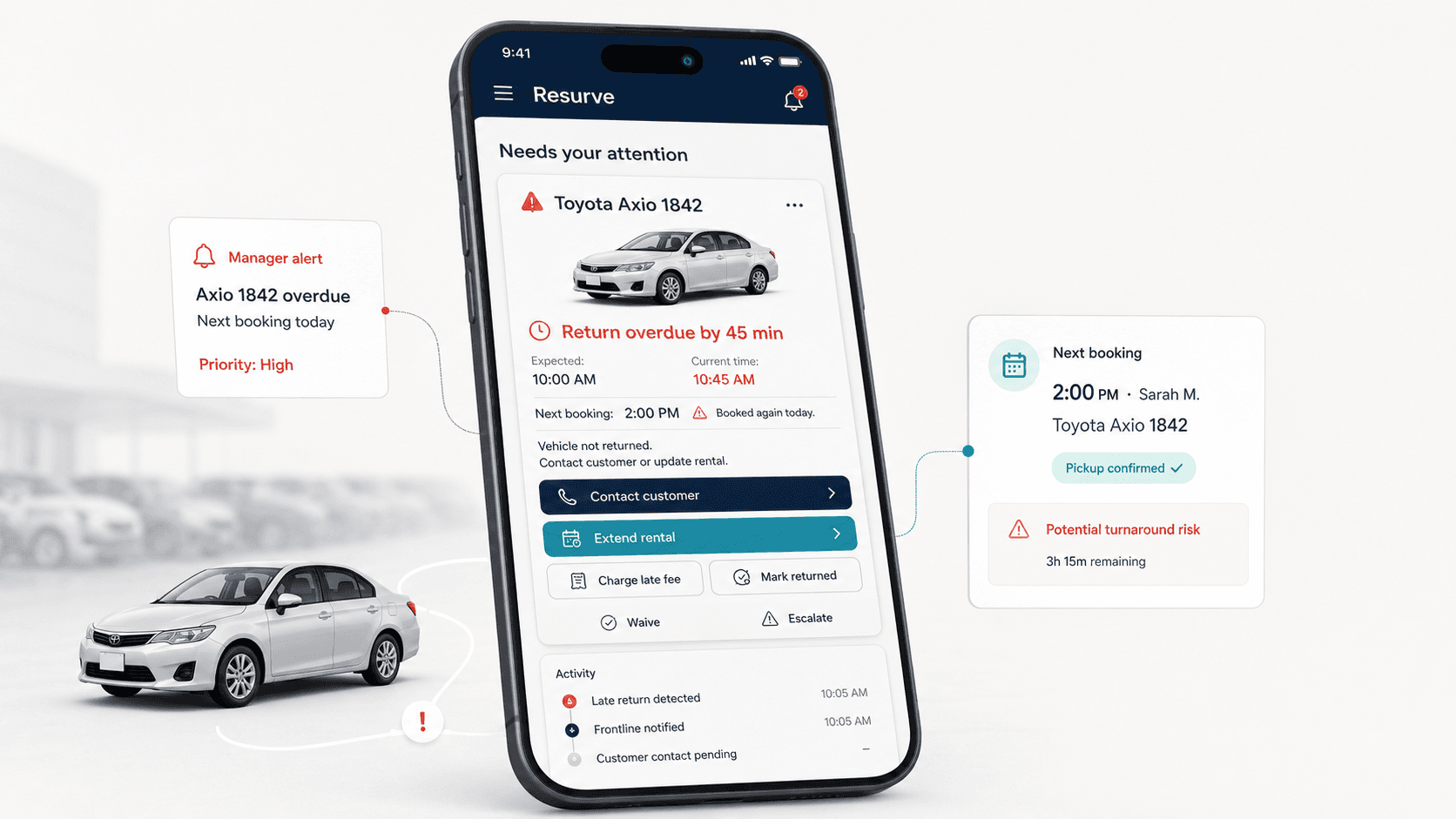
Suppose the Axio was due back at 10:00 AM.
At 10:45 AM, it still has not returned.
A basic rental system can change:
On rent → Late
That is useful information.
But the business does not need information alone.
It needs action.
Someone needs to know the customer is late.
Someone may need to contact them.
There may be another booking at 2:00 PM.
The rental might need extending.
A late fee might need charging.
A manager may decide to waive it.
The vehicle eventually needs to be marked returned.
If money becomes due, that needs to go somewhere too.
So the real flow is closer to:
Late detected → Right person notified → Next action shown → Decision made → Operational state updated → Money consequence recorded → Issue actually resolved
That is what Flow Dynamics is designed to do.
Resurve should not merely tell us what happened. It should help the right person deal with what happened.
The work should come to the employee
Traditional business software often makes employees search.
Open the dashboard.
Find the rental.
Open the customer.
Check the notes.
Look for the payment.
Message the manager.
Figure out the policy.
Then decide what to do.
That creates hidden work.
Flow Dynamics turns the model around.
The system already knows the context.
So the employee should see something closer to:
Toyota Axio 1842
Return overdue by 45 min
Next booking: 2:00 PM
Contact customer · Extend rental · Charge late fee · Mark returned
The software has done the searching.
The person performs the judgement or action.
That difference sounds small.
Across hundreds or thousands of rentals, it is not small at all.
If Resurve knows, why enter it again?
The same principle applies to money.
Imagine the rental is extended by another day.
The operational system already knows:
- the dates changed;
- the rental total changed;
- an additional amount became due.
Why should someone later open accounting software and recreate that event?
Or consider a deposit.
If MUR 1,000 is retained for fuel and MUR 3,000 for excess mileage, the system already knows why the money moved.
The financial system should not need the story retold.
That leads to one of the principles behind Resurve:
If Resurve knows the economic event, automate it deterministically. If Resurve does not know, ask.
Known event?
Move it through.
Unknown amount or judgement?
Surface it to the right person.
Never invent it.
This is how operations and accounting begin to become one system rather than two systems connected by manual entry.
The books of the business meet the books of the car
Traditional accounting answers essential questions.
How much revenue did we earn?
What did we spend?
What do customers owe us?
What do we owe suppliers?
What assets do we own?
What tax is due?
Resurve can carry that financial truth.
But a car-rental company needs another layer too:
The books of the car.
For Axio 1842, the business may eventually know:
Acquisition cost · Rental revenue · Mileage · Utilisation · Cleaning · Maintenance · Repairs · Tyres · Insurance · Damage · Downtime · Depreciation
Those numbers become much more useful when they are connected.
An accountant might tell us:
Repairs this year: MUR 480,000
Resurve can potentially tell us:
MUR 137,000 came from Axio 1842.
And:
That vehicle generated MUR 246,000 in rental revenue and spent 31 days unavailable.
Now we are not merely looking at an expense category.
We are understanding the economics of an asset.
The connection is the product
Different systems naturally see different slices of the business.
A booking system sees:
Availability → Reservation → Customer
A fleet system sees:
Vehicle → Mileage → Service → Status
Accounting sees:
Revenue → Expense → Asset → Liability
A contract system sees:
Agreement → Signature → Evidence
But the business itself does not experience those things separately.
The business experiences:
Customer → Booking → Vehicle → Contract → Payment → Pickup → Mileage/Fuel → Return → Deposit/Damage → Maintenance → Finance → Profitability
That is the important difference.
The moat is not any individual box.
It is the connection between the boxes.

One business event. One connected operating history.
Why does that matter?
Because disconnected systems create repeated work.
Someone has to move information.
Someone has to reconcile different versions of the truth.
Someone has to remember what happened operationally when looking at the money later.
Someone has to notice that a maintenance bill belongs to the same vehicle that has already been underperforming.
When the system owns the connections, much of that work can disappear.
And something else becomes possible.
The business can begin to understand itself at a level that separate applications struggle to provide.
Not simply:
How much money did we make?
But eventually:
Which cars made it?
Which cars consumed it?
Which rentals created problems?
Which vehicle classes are underutilised?
Which decisions should we review?
That is where the next part of the Resurve story begins.
A rental is more than a booking
A booking tells us that someone wanted a car.
A living rental file tells us what actually happened.
It connects the customer experience to the physical vehicle.
The physical vehicle to the operation.
The operation to money.
And the money back to the economics of the asset.
One rental. One connected operating history.
That is why we do not think of Resurve as simply another booking system.
We are building the layer that connects:
Commerce · Operations · Assets · Finance
Because once those truths live together, software can start doing something much more valuable than storing records.
It can start helping the business understand what those records mean.
The connection is the product.
And that is where we go next.
Ещё

If Your Software Creates More Work, What’s the Point?
More features do not always make software better. This article looks at why good car rental software should handle complexity in the background while keeping everyday work simple for employees, managers and owners.
21 Aug 2026 · 3 min
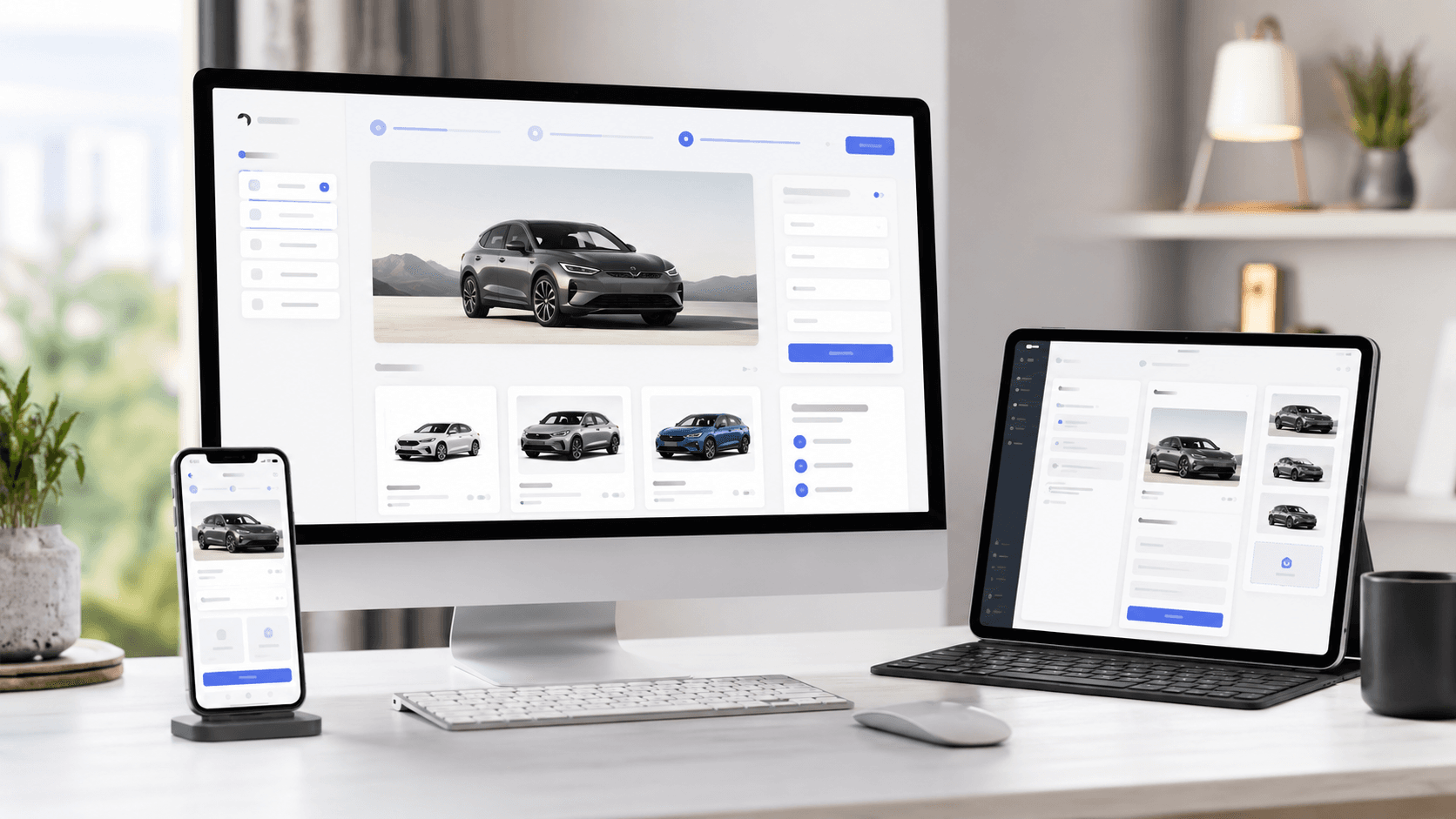
You Shouldn’t Need to Become a Web Designer to Rent Cars Online
Car rental operators should not have to build and connect complicated websites just to accept bookings. This article explains why getting online should be as simple as adding your vehicles, prices, policies and business information.
21 Aug 2026 · 3 min
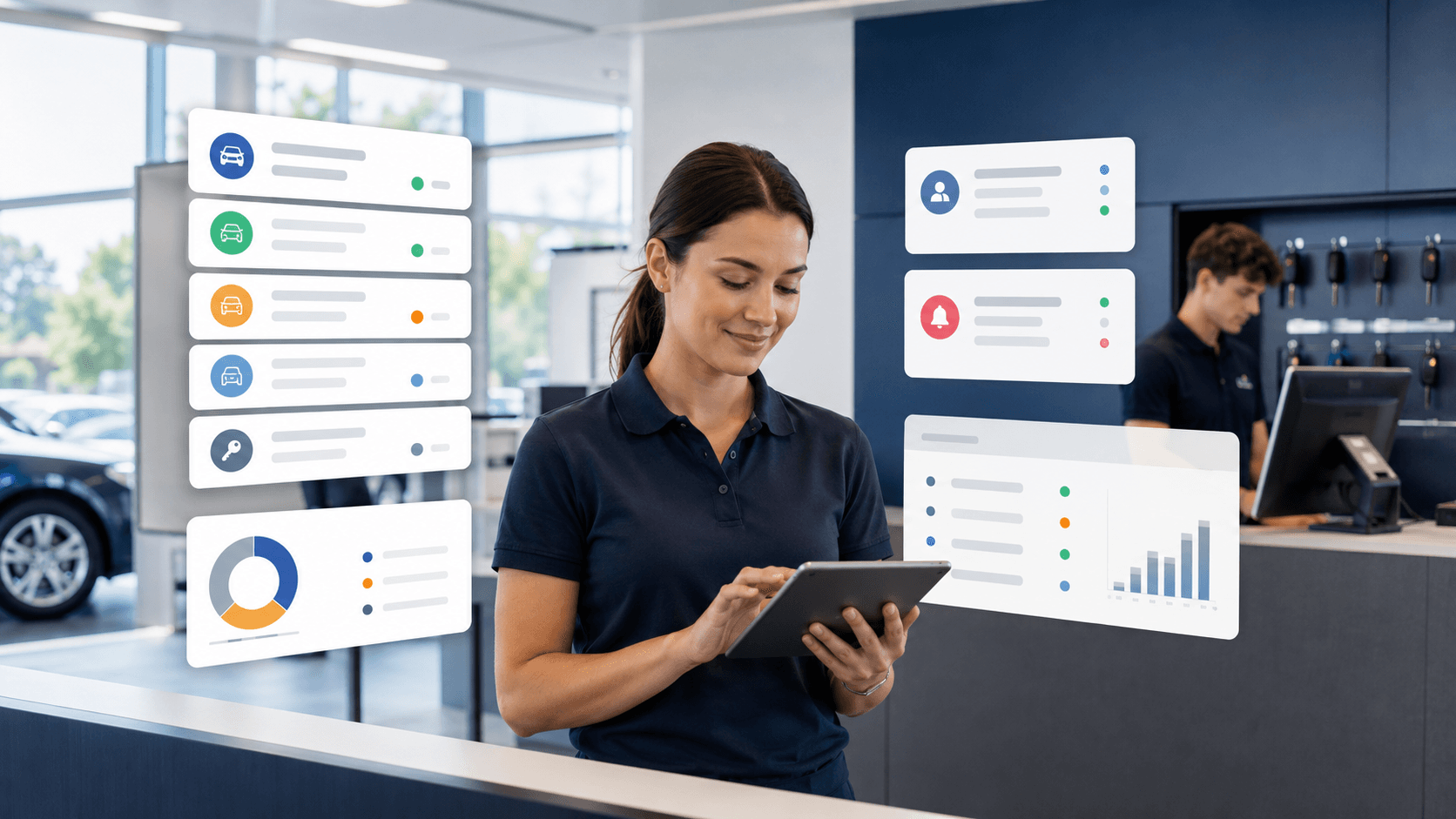
Your Staff Shouldn’t Need to Ask You What to Do Next
When employees constantly rely on the owner for instructions, the business becomes harder to scale. This article looks at how clearer workflows can help staff see their work, managers see problems and owners stay focused on the business.
21 Aug 2026 · 3 min
Комментарии